In the competitive restaurant industry, online reviews can make or break a business. A study by BrightLocal found that 87% of consumers read online reviews for local businesses, and 79% trust online reviews as much as personal recommendations. For restaurants specifically, a one-star increase in Yelp rating can lead to a 5-9% increase in revenue.
However, asking customers to leave a review often feels intrusive, or the process is too cumbersome for them to bother. The gap between a satisfied diner and a published five-star review is filled with friction: remembering to do it later, finding the right platform, navigating to your business listing, logging in, and typing the review.
Enter NFC technology—a simple, elegant solution that transforms this multi-step obstacle course into a single tap.
The Online Review Reality for Restaurants
Before diving into the solution, let's understand the problem's scope:
Why Reviews Matter More Than Ever
Search Rankings: Google's local search algorithm heavily weighs review quantity, quality, and recency. Restaurants with more recent positive reviews rank higher in "restaurants near me" searches—the moment of highest purchase intent.
Consumer Trust: ReviewTrackers research shows that 94% of diners say a negative review has convinced them to avoid a restaurant. Conversely, 90% are influenced by positive reviews when making dining decisions.
Competitive Differentiation: In saturated markets, reviews become a primary differentiator. When two restaurants offer similar cuisines at similar price points, the one with 4.5 stars and 300 reviews wins over the one with 4.0 stars and 50 reviews.
Resilience Against Negatives: A robust volume of positive reviews provides insulation against the inevitable negative review. One bad review among 200+ is a rounding error. One bad review among 12 is a crisis.
The Traditional Review Request Problem
Most restaurants rely on one or more of these flawed strategies:
Verbal Requests: Servers ask: "If you enjoyed your meal, would you mind leaving us a review online?"
- Problem: Puts social pressure on customers (they feel obligated to say yes even if they don't intend to follow through)
- Problem: Requires customers to remember later
- Problem: Doesn't provide a specific platform or easy access
- Problem: Inconsistent (depends on server memory and motivation)
Printed Requests on Receipts or Table Tents: "Leave us a review on Yelp!" with a generic social media icon.
- Problem: Requires customers to manually search for your business
- Problem: They might search incorrectly and not find you
- Problem: By the time they see the receipt, they're already thinking about their next activity
- Problem: No tracking of effectiveness
QR Codes: A scannable code that links to review platforms.
- Better than verbal or text-only: But still requires customers to:
- Pull out phone
- Open camera app
- Position and focus on QR code
- Wait for scan to register
- Tap the notification
- Navigate to review page
While QR codes reduce friction compared to manual searches, they're not frictionless. Research shows QR code scan rates average only 15-25% even when prominently displayed.
The NFC Solution: Tap-to-Review
NFC (Near Field Communication) tags eliminate virtually all friction from the review request process.
How It Works
Physical Placement: Small NFC tags are placed strategically throughout your restaurant:
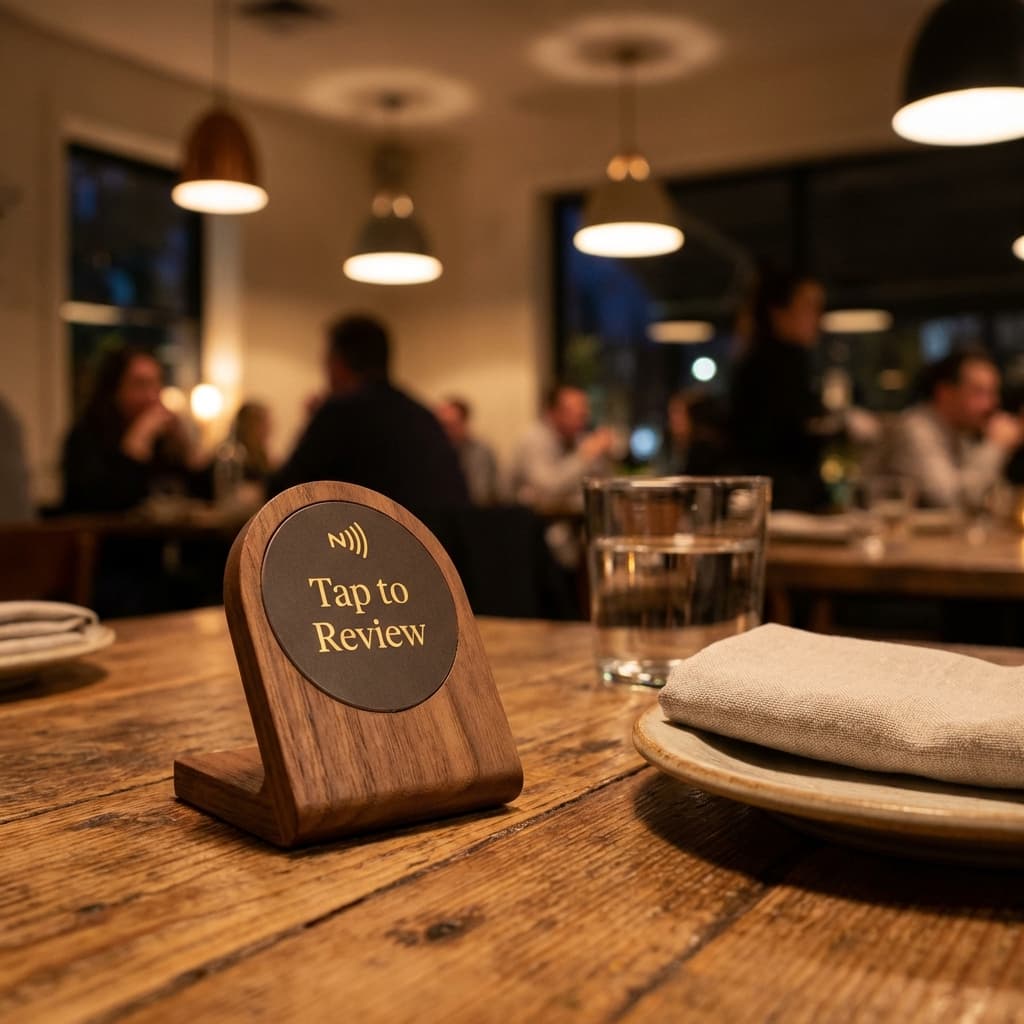
- Embedded in table tents
- Affixed to bill folders
- Built into table surfaces (for higher-end establishments)
- Placed near the exit
- Integrated into takeout packaging
The Customer Experience:
- Customer finishes their meal and sees a message: "Loved your experience? Tap your phone here to share!"
- They tap their smartphone against the tag
- Their phone immediately opens to your Google Business, Yelp, or TripAdvisor review page
- They're already logged in (most platforms keep users logged in)
- They tap the star rating and optionally add comments
- Review is published in under 30 seconds
The Platform Targeting: Smart NFC implementations can route to different platforms based on:
- Device type: iPhones to Apple Maps reviews, Android to Google
- Customer preferences: Return customers to their preferred platform
- Strategic needs: If your Yelp rating is lagging, prioritize that platform
Why NFC Outperforms Other Methods
Immediacy: The moment of peak satisfaction—right after a great meal—is when customers are most motivated to share positive feedback. NFC captures this moment instead of relying on later recall.
Zero Barrier: Tapping requires no conscious decision-making. It's almost thoughtless. Compare this to the multi-step process of "I'll review them when I get home" (which never happens).
Touch-Free Hygiene: Post-pandemic, customers appreciate contactless interactions. They're already comfortable with tap-to-pay; tap-to-review feels natural and hygienic.
Works in Low Light: Unlike QR codes, which can be difficult to scan in dim restaurant lighting (candlelit tables, mood lighting), NFC works perfectly in any lighting condition.
Feels Modern: Using NFC technology signals that your restaurant is forward-thinking and tech-savvy—qualities that correlate with overall quality in customers' minds.
Implementation: Step-by-Step Guide
Phase 1: Platform Selection (Week 1)
Decide Which Review Platform to Prioritize:
Google Business Profile:
- Pros: Dominates local search, shows up in Google Maps, free
- Cons: Harder to manage responses compared to Yelp
- Best for: Restaurants relying on local search and Google Maps discovery
Yelp:
- Pros: Dominant in major urban markets, detailed review ecosystem, trusted by foodies
- Cons: Strict review policies, aggressive about filtering suspicious reviews
- Best for: Independent restaurants in food-forward cities (SF, NYC, Portland, Austin)
TripAdvisor:
- Pros: Crucial for tourist-heavy locations, international audience
- Cons: Less important for neighborhood restaurants
- Best for: Restaurants in tourist districts, hotel restaurants, destination dining
Facebook:
- Pros: Easy sharing, high visibility among existing fans
- Cons: Less discovery value, not a primary restaurant review platform
- Best for: Community-focused neighborhood restaurants with strong local following
Pro Strategy: Use intelligent routing. First tap goes to your weakest platform that needs boosting. Second tap (if they're enthusiastic enough to tap again) goes to your strongest platform for reinforcement.
Phase 2: NFC Tag Procurement (Week 1-2)
Tag Specifications:
NFC Type: NTAG213 or NTAG215 chips are standard and universally compatible with iOS and Android.
Form Factor Options:
- Stickers: Cheapest ($0.50-1 each), easy to place anywhere, but can peel over time
- Cards: More premium feel ($2-5 each), durable, good for table placement
- Epoxy Tags: Embedded in clear resin ($3-7 each), waterproof, elegant for upscale environments
- Custom Branded: Your logo and design ($5-15 each), premium appearance
Memory Size: 144 bytes (NTAG213) is sufficient for a URL. If you want to store more data or enable advanced features, NTAG215 (504 bytes) or NTAG216 (888 bytes) provide headroom.
Quantity Calculation:
- Table count × 1.5 (extras for replacements and high-traffic areas)
- Example: 25 tables = 38 tags
- Add 10-20 tags for entrances, takeout, and bar areas
Vendors:
- TagsForDroid (custom printing, bulk pricing)
- GoToTags (premium options, good customization)
- Amazon (budget options, bulk NTAG packs)
- Local NFC providers (search "[your city] NFC tags")
Cost Expectations: For a mid-size restaurant (30-40 tags), expect $100-500 depending on quality level.
Phase 3: Programming and Testing (Week 2)
Tag Programming:
Tools Needed:
- NFC-capable smartphone (iPhone 7+, most Android devices)
- NFC writing app:
- iOS: NFC Tools, Shortcuts app (built-in)
- Android: NFC Tools, Trigger
What to Program:
Direct Review Link Method: Encode a URL that points directly to your "leave a review" page.
Finding Your Google Review Link:
- Google your business name
- Scroll to reviews section
- Click "Write a review"
- Copy the URL (it will look like:
https://search.google.com/local/writereview?placeid=YOUR_PLACE_ID)
Finding Your Yelp Review Link:
https://www.yelp.com/writeareview/biz/YOUR-BUSINESS-URL
Smart Landing Page Method (Advanced):
Create a custom landing page (yourrestaurant.com/review) that:
- Thanks the customer
- Offers buttons for multiple platforms (Google, Yelp, Facebook)
- Tracks which platform they chose (analytics)
- Allows you to A/B test messaging
- Can rotate which platform is most prominently displayed
This gives you flexibility to change destinations without reprogramming physical tags.
Testing Protocol: Before deploying:
- Test each tag with multiple devices (iPhone, Android)
- Verify the link opens correctly
- Check that users land on the right page
- Ensure it works with phones in cases
- Test in low-light conditions (if using QR backup)
Phase 4: Strategic Placement (Week 3)
High-Value Locations:
On Tables:
- Table tents: "Loved your meal? Tap here to share!"
- Embedded in menu holders
- Built into table surface (luxury option)
At Payment Point:
- Bill folders: Capture satisfaction at checkout moment
- Receipt holders
- Credit card return tray
Exit Touchpoint:
- Near entrance/exit: Last impression as customers leave
- Hostess stand
Takeout/Delivery:
- Attached to takeout bags: "Thanks for supporting us! Tap to review"
- Inside delivery packaging
- On takeout menus
Placement Psychology:
Timing Matters: Place tags at moments of peak satisfaction:
- Right after dessert is served
- When the check is delivered
- Immediately after a server resolves an issue exceptionally
- As customers prepare to leave (if they're chatting happily)
Visual Prominence Without Pressure: Tags should be visible but not aggressive. Messages should invite, not demand:
- ✓ "Enjoyed your experience? We'd love to hear!"
- ✗ "Leave us a 5-star review NOW!"
Multiple Touchpoints: Don't rely on one placement. Use 3-4 different locations:
- Table tent (during meal)
- Bill folder (at payment)
- Exit area (final touchpoint)
This gives multiple opportunities without being pushy.
Phase 5: Staff Training (Week 3)
What Staff Need to Know:
The Basics:
- What NFC is and how it works
- Where tags are located
- How to demonstrate if customers ask
When to Mention: Train servers to subtly draw attention after positive interactions:
- "I'm so glad you enjoyed the [specific dish]! If you'd like to share your experience, just tap your phone on the table tent."
- "Thanks for being so patient with us tonight. If you have a moment to leave feedback, there's an easy tap option on your bill folder."
Handling Questions:
- "Does it work with my phone?" → "Yes, works with iPhone and Android!"
- "Do I need an app?" → "Nope, just tap and your phone does the rest"
- "What if I don't want to?" → "No problem at all! Enjoy the rest of your evening."
Privacy Note: Ensure staff clarify: "It just opens the review page. You're in control of what you share."
Phase 6: Incentive Strategy (Optional but Effective)
Should You Incentivize Reviews?
Platform Policies:
- Google: Prohibits incentivizing reviews
- Yelp: Strictly against their TOS, can result in penalties
- TripAdvisor: Discouraged, can lead to review removal
The Compliant Workaround: Don't incentivize positive reviews specifically. Instead, incentivize feedback:
- "Share your honest feedback and get 10% off your next visit"
- "Tap to tell us how we did—you'll get a free appetizer code"
This is generally acceptable because you're not specifically asking for positive public reviews, just encouraging feedback (which can be positive or negative, public or private).
Best Practice: Focus on creating such excellent experiences that customers want to review you without incentives. Incentives can boost volume, but authentic enthusiasm creates the most convincing reviews.
Advanced Tactics for Maximum Review Generation
The Feedback Fork: Public vs. Private
Not every customer will have a perfect experience. Smart NFC implementations create a fork in the road:
The Landing Page Strategy: When customers tap, they see:
- "How was your experience?"
- Two buttons: "😊 Great!" and "😐 Could be better"
If "Great": → Redirect to public review platforms (Google, Yelp) → Message: "Awesome! Mind sharing on Google?"
If "Could be better": → Redirect to private feedback form (your own system) → Message: "We're sorry to hear that. Tell us what happened so we can make it right."
Why This Works:
- Happy customers amplify your public reputation
- Unhappy customers vent privately (preventing public damage)
- You get actionable feedback from detractors
- You can address issues before they become public reviews
Technical Implementation: Use a simple web form with conditional logic. Services like Typeform, JotForm, or custom development can handle this easily.
The Surprise Delight Follow-Up
When a customer leaves a positive review after tapping your NFC tag, you know who they are (if your landing page captured their email before redirecting to the review platform).
Immediate Response: Send a thank-you email within 24 hours:
- Subject: "Thank you, [Name]! Here's a little something"
- Body: Personal thanks + discount code for next visit
This creates a positive reinforcement loop:
- Customer reviews you (expends effort, even if minimal)
- You reward them (unexpected delight)
- They return and have another great experience
- They're even more likely to review again or recommend you
Multi-Location Strategy
If you operate multiple locations, get strategic:
Location-Specific Tags: Each location's NFC tags route to that specific location's review page. Don't send someone who dined at your Brooklyn location to leave a review for your Manhattan location.
Performance Tracking: Use unique URLs for each location:
- Brooklyn:
yourrestaurant.com/review-brooklyn - Manhattan:
yourrestaurant.com/review-manhattan
This lets you track which location generates more review engagement and identify best practices to replicate.
Competitive Internal Benchmarking: Create friendly competition among locations. Share monthly stats:
- "Brooklyn location generated 47 new reviews this month!"
- Award bonuses to locations that hit review targets
Seasonal and Event-Based Campaigns
Don't treat review generation as static. Create campaigns:
Holiday Push: "Help us make someone's holiday special! Share your experience and we'll donate $1 to [local charity]"
New Menu Launch: "Tried our new spring menu? Tap to let others know what you think!"
Anniversary Celebrations: "Help us celebrate 10 years! Share your favorite memory and be entered to win a dinner for two."
Slow Periods: During typically slow times (Tuesday lunch, early weeknights), extra-emphasize review requests to build reputation during periods with natural capacity.
Monitoring and Responding: The Ongoing Work
Generating reviews is only half the equation. Managing them is equally critical.
Review Monitoring Systems
Set Up Alerts: Get notified immediately when new reviews appear:
- Google Business app (push notifications)
- Yelp for Business app
- Third-party aggregators (ReviewTrackers, Podium, Birdeye)
Frequency: Check reviews daily, respond within 24 hours when possible.
Response Strategy
For Positive Reviews (4-5 stars):
- Thank them by name
- Reference specific details they mentioned ("We're so glad you enjoyed the grilled salmon!")
- Invite them back ("Can't wait to serve you again!")
- Keep it personal, not templated
For Mixed Reviews (3 stars):
- Thank them for feedback
- Address specific concerns mentioned
- Explain improvements or context (without being defensive)
- Invite offline conversation to make it right
For Negative Reviews (1-2 stars):
- Respond publicly, but keep it brief
- Acknowledge their experience without admitting fault if unwarranted
- Take the conversation offline: "Please contact us directly at [phone/email] so we can make this right"
- Never argue publicly (you're performing for future readers, not convincing the reviewer)
Template Framework: "Hi [Name], thank you for your feedback. We're sorry we didn't meet expectations with [specific issue]. This isn't typical of our service, and we'd love the chance to make it right. Please reach out to us directly at [contact info]. - [Manager Name]"
Analytics: What to Track
Volume Metrics:
- New reviews per month
- Total review count across platforms
- Reviews generated per NFC tag location (if using unique URLs)
Quality Metrics:
- Average star rating
- Sentiment analysis (positive keywords vs. negative)
- Review length (longer reviews are often more credible)
Conversion Funnel:
- NFC tag taps (if using an intermediate landing page)
- Landing page views
- Click-throughs to review platforms
- Completed reviews
Formula: Conversion Rate = (Completed Reviews ÷ NFC Tag Taps) × 100
Benchmark: 30-50% is strong. Lower suggests friction in the process or disengaged customers.
ROI Tracking: Correlate review increases with:
- Reservation volume changes
- Revenue changes
- Customer acquisition cost changes
- Search ranking improvements
Case Studies: Real Results
Case Study 1: Family Italian Restaurant, Suburban Market
Situation:
- 15-year-old establishment
- Strong local reputation, weak online presence
- 23 Google reviews, 3.9 stars (several old negative reviews dragging down average)
- Wanted to compete with new chains opening nearby
Implementation:
- 30 NFC tags placed on tables and bill folders
- Messaging: "Family-owned since 2008. Share your experience!"
- Landing page with feedback fork (public vs. private)
- Staff trained to mention tags after delivering meals
Results After 4 Months:
- 127 new Google reviews (from 23 to 150)
- Average rating increased to 4.6 stars
- Moved from #8 to #3 in "Italian restaurant near me" local search
- Negative review percentage dropped from 22% to 8% (volume dilution effect)
- Reservation requests increased 41%
- Revenue up 28%
ROI: Investment: $450 (tags + landing page development) Additional quarterly revenue: ~$32,000 ROI: 7,000%+
Case Study 2: Fast-Casual Chain, 8 Locations
Situation:
- Rapid expansion, inconsistent review presence across locations
- Some locations had 200+ reviews, others had fewer than 30
- Corporate wanted to standardize online reputation management
Implementation:
- Rolled out NFC tags to all locations simultaneously
- Each location had location-specific review links
- Monthly review generation contests between locations
- Central dashboard tracking performance by location
Results After 6 Months:
- All locations surpassed 100 reviews (previously ranged from 18 to 230)
- Average rating across all locations increased from 3.8 to 4.3
- Locations with previously poor online presence saw dramatic traffic increases (up to 60%)
- Identified best practices from highest-performing locations and replicated chain-wide
- Customer complaints decreased 34% (issues addressed privately via feedback fork)
Key Insight: Standardization created accountability. Underperforming locations couldn't blame "different demographics" when sister locations thrived with the same system.
Case Study 3: High-End Steakhouse, Tourist District
Situation:
- Premium pricing ($80+ average per person)
- Competing with established national brands
- Strong on Yelp (4.5 stars, 300 reviews) but weak on TripAdvisor (3.8 stars, 45 reviews)
- Needed TripAdvisor strength for tourist traffic
Implementation:
- NFC tags specifically routed tourists to TripAdvisor, locals to Yelp (determined by asking during reservation)
- Premium metal card tags embedded in leather bill folders (brand-appropriate)
- "Share your experience with travelers" messaging for TripAdvisor prompts
- Server verbal cues for international guests
Results After 5 Months:
- TripAdvisor reviews increased from 45 to 210
- Rating improved to 4.4 stars
- Earned TripAdvisor "Certificate of Excellence"
- Tourist bookings (tracked via source in reservation system) increased 53%
- Maintained Yelp performance while building TripAdvisor presence
Lesson: Different platforms matter for different audiences. Strategic routing based on customer segments maximizes impact.
Common Mistakes to Avoid
Mistake 1: Only Asking When Things Go Perfectly
Don't wait for absolute perfection. A consistent 4.3-star rating with volume is more valuable than a 5.0 with 12 reviews. Ask for reviews regularly from satisfied (not just ecstatic) customers.
Mistake 2: Ignoring the Private Feedback
The feedback fork generates private complaints. If you don't monitor and respond to these, you've wasted the opportunity. Assign someone to check daily and resolve issues.
Mistake 3: Templated Responses
Responding to every review with "Thanks for your feedback!" feels robotic. Personalize responses with specific references to their comments.
Mistake 4: Placing Tags Where They're Ignored
Don't hide tags. Test placement and monitor which locations get the most engagement (use unique URLs per placement to track).
Mistake 5: No Staff Buy-In
If your staff doesn't understand or believe in the system, they won't encourage customers to use it. Invest in training and show them the results.
Mistake 6: Setting and Forgetting
Review generation requires ongoing optimization. Test different messaging, placements, timing. Monitor what works and iterate.
The Future: Emerging Trends
AI-Generated Response Suggestions: Platforms are beginning to offer AI-powered response drafts based on review content, saving time while maintaining personalization.
Voice Reviews: NFC tags that prompt customers to leave voice reviews (converted to text automatically) for an even lower-friction option.
Augmented Reality Integration: Tap the tag and see a holographic version of the dish being reviewed or a message from the chef thanking reviewers.
Blockchain Verification: Verified reviews using blockchain to prove authenticity, combating fake review problems that plague the industry.
Hyper-Personalized Requests: Systems that know a customer is a regular and prompt: "Your opinion matters to our community. Share your favorite dish!"
Conclusion: Reviews Are Your Digital Word-of-Mouth
In an era where diners research restaurants on their phones before even leaving the house, your online reviews are often the first—and sometimes only—impression you make.
NFC technology doesn't create great reviews. You do that with excellent food, service, and atmosphere. What NFC does is remove the barrier between a satisfied customer and a public endorsement.
It's the digital equivalent of a satisfied diner telling their friends about your restaurant—except it scales infinitely and reaches strangers who trust online reviews as much as personal recommendations.
The restaurants thriving in the 2020s aren't necessarily those with the best food (though that helps). They're the ones who understand that customer satisfaction AND amplification of that satisfaction are equally important.
NFC gives you the amplification. Your kitchen and staff create the satisfaction.
Combine both, and you build an online reputation that becomes a self-reinforcing growth engine: more reviews → better visibility → more customers → more reviews.
The question isn't whether you can afford to implement NFC review generation. It's whether you can afford not to while your competitors pull ahead.
Start small. Order 10 tags. Test at a few tables. Track the results. Then scale what works.
Your next five-star review is just a tap away.