There is a famous adage in business: "It costs 5 times more to acquire a new customer than to retain an existing one." Some studies put that multiplier even higher—up to 25 times more expensive when you factor in all the marketing, sales, and onboarding costs required to convert a stranger into a paying customer.
Yet, despite this well-documented reality, many small businesses focus 90% of their budget on ads for new leads and only 10% on keeping the people who already walked through the door. This is a strategic mistake that leaves money on the table and undermines long-term business sustainability.
In 2025, technology makes retention automatic, measurable, and scalable. Here is how smart businesses are using digital tools to turn one-time buyers into lifetime advocates.
Understanding the Retention Economics
Before diving into tactics, let's examine why retention matters so much:
The Revenue Reality
According to research by Bain & Company, increasing customer retention rates by just 5% increases profits by 25% to 95%. This remarkable leverage comes from several factors:
Higher Lifetime Value: A customer who makes one $30 purchase is worth $30. A customer who returns monthly for a year is worth $360. A customer who stays for five years is worth $1,800. The difference is transformative for small business economics.
Lower Service Costs: New customers require education, hand-holding, and patience. They ask basic questions, make mistakes during checkout, and require more staff attention. Repeat customers know your systems, understand your offerings, and transact efficiently.
Word-of-Mouth Amplification: Loyal customers become unpaid marketing agents. They recommend you to friends, defend you on social media, and provide testimonials. This earned media is far more valuable than paid advertising because it carries authentic credibility.
Price Insensitivity: Research shows that loyal customers are willing to pay 10-20% premium prices compared to new customers. They trust your quality and value convenience over bargain hunting.
The Competitive Moat
In saturated markets, customer loyalty becomes a defensible competitive advantage. A new competitor might match your prices or products, but they can't easily steal customers who have emotional connections, accumulated rewards, and established habits with your business.
1. Digital Loyalty Programs: Beyond the Punch Card
The paper punch card was revolutionary in 1985. Today, it's friction personified.
The Problem with Physical Cards
Consider the customer journey with traditional punch cards:
- Customer makes purchase
- Staff asks: "Do you have your loyalty card?"
- Customer digs through wallet or purse
- Customer realizes: "I forgot it at home" or "I think I lost it"
- Staff offers: "Would you like a new one?"
- Customer now has multiple cards with partial punches
- Customer never accumulates enough punches to redeem
- Card ends up in a drawer or landfill
Redemption rates for paper loyalty cards hover around 10-15%. That means 85-90% of intended rewards never create the desired behavior change.
The Tech Solution: Digital Loyalty in Mobile Wallets
NFC-enabled loyalty passes stored in Apple Wallet or Google Pay solve every pain point:
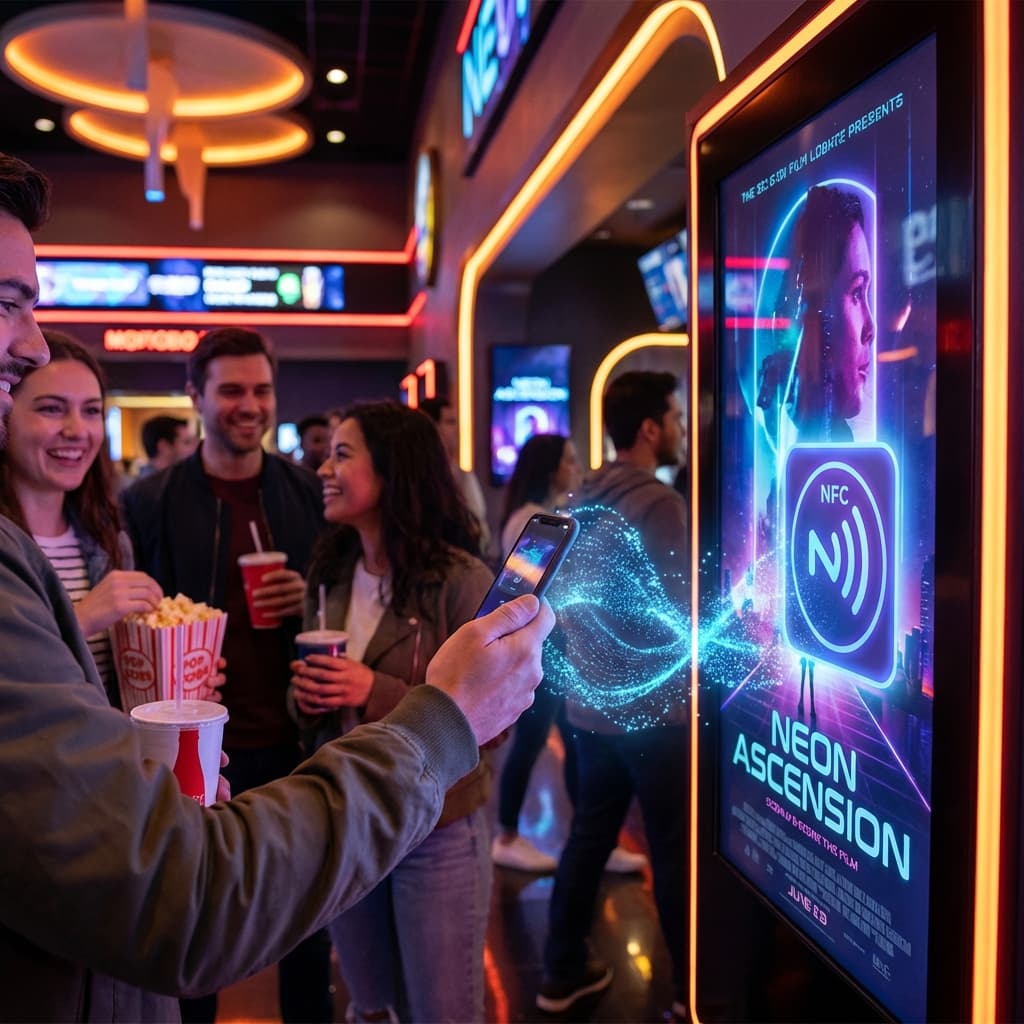
Frictionless Enrollment: Customer taps their phone on an NFC tag at checkout. A digital loyalty card instantly saves to their mobile wallet. No app download, no form filling, no email verification. Total time: 3 seconds.
Always Available: People forget their wallets. They never forget their phones. The loyalty card is always in their pocket, eliminating the "I forgot it" excuse.
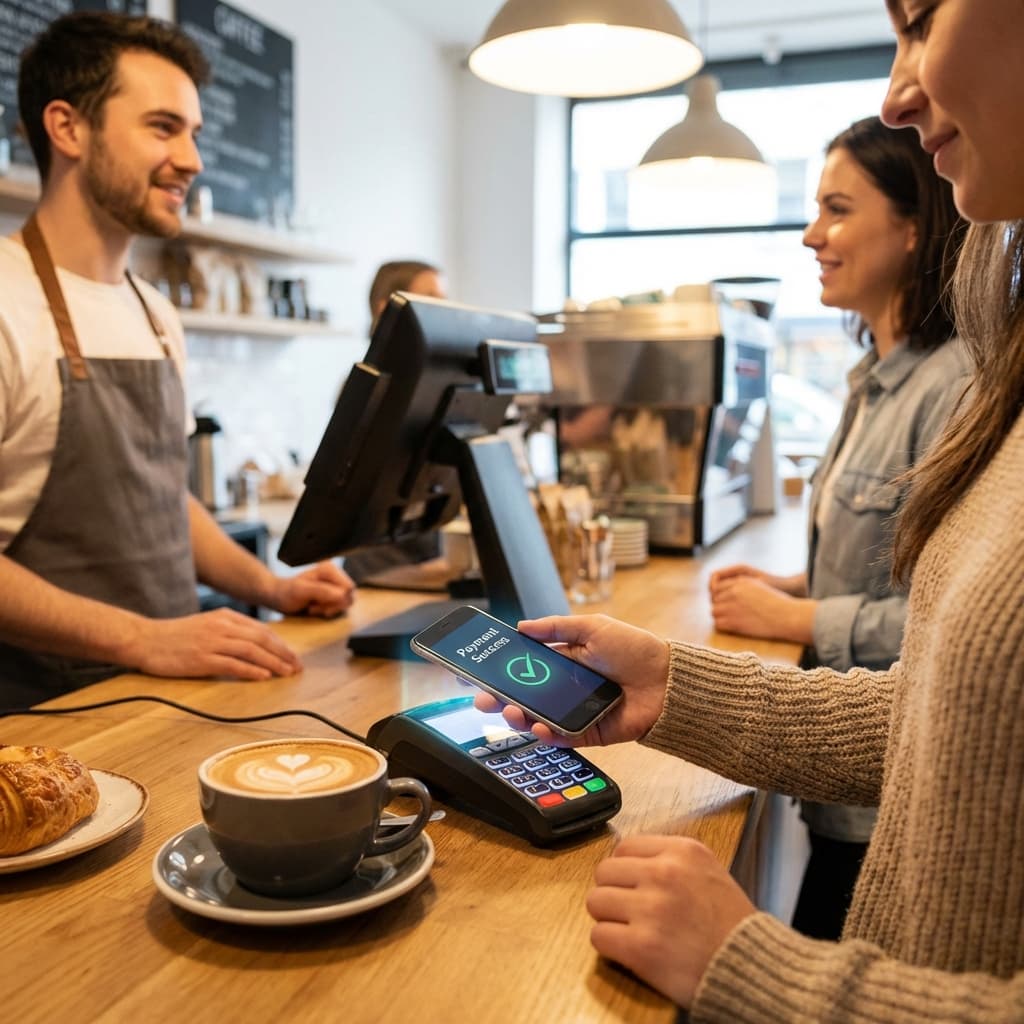
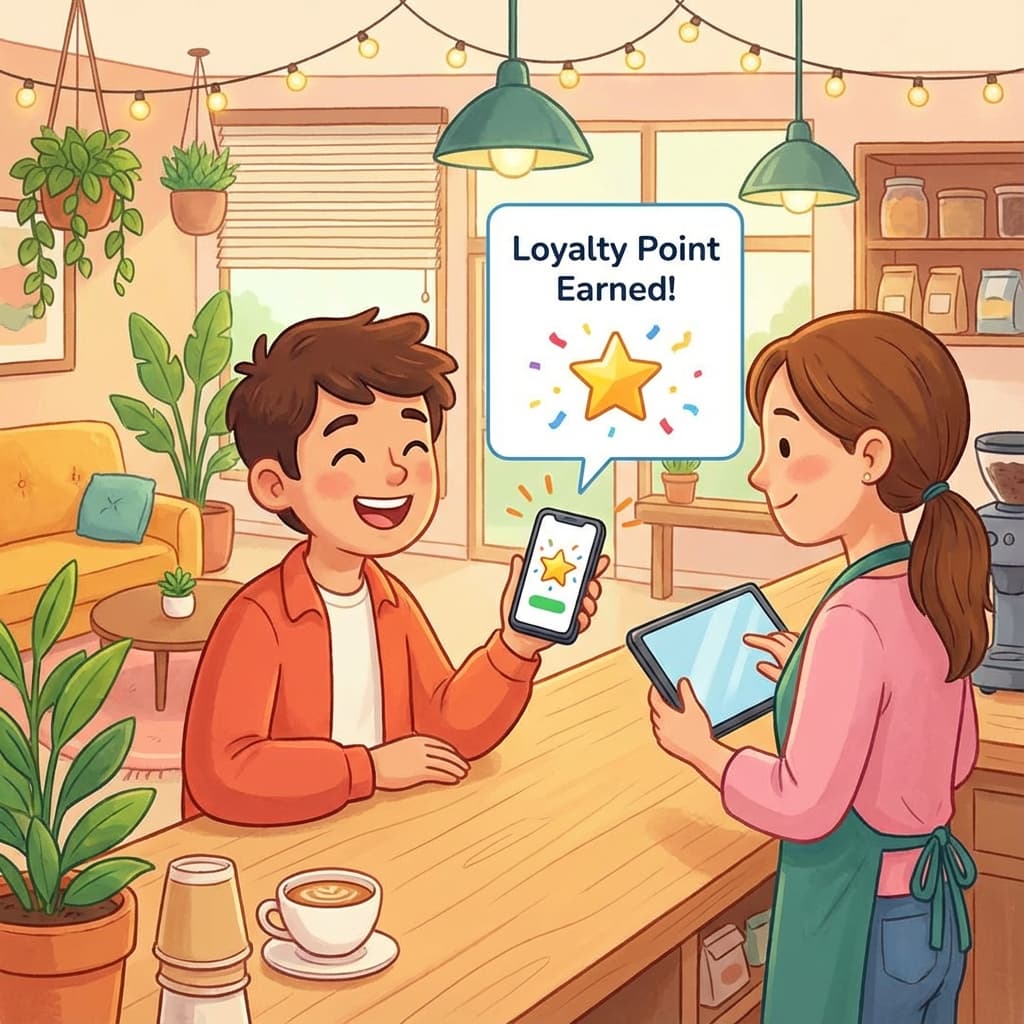
Automatic Tracking: When customers tap their phone at checkout, points add automatically. No manual stamping, no fraud, no errors. The system logs the transaction instantly.
Smart Notifications: When a customer reaches reward threshold (say, 10 points for a free item), their phone buzzes immediately: "Congrats! You've earned a free coffee. Redeem anytime this month."
Time-Sensitive Urgency: Modern digital loyalty systems can create urgency: "Your reward expires in 3 days!" This drives return visits within specific timeframes.
Implementation Guide
Step 1: Choose a Platform Options include:
- WifiNFC (integrates loyalty with Wi-Fi access)
- Loyalty Lion (comprehensive loyalty platform)
- Square Loyalty (integrated with Square POS)
- FiveStars (enterprise-grade automation)
- Belly (tablet-based system with NFC support)
Step 2: Design Your Program Structure Common models:
- Points per dollar: Earn 1 point per $1 spent; 100 points = $10 reward
- Visit-based: 10 visits = free item
- Tiered status: Bronze/Silver/Gold levels with escalating benefits
- Gamified challenges: "Visit 3 times this week for bonus points"
Step 3: Deploy NFC Tags Place programmable NFC tags at:
- Checkout counters (primary touchpoint)
- Table tents (restaurants and cafés)
- Entrance signage
- Receipts or packaging
Step 4: Train Staff Ensure your team can:
- Explain the program in one sentence
- Help customers tap their phones correctly
- Troubleshoot basic issues (ensure phone is unlocked, try different position)
- Check point balances upon request
Step 5: Promote Aggressively The first 90 days are critical:
- Offer double points for enrollment
- Display prominent signage
- Include information on receipts
- Mention it verbally at every transaction
- Post about it on social media
Advanced Features
Once your basic program is running, layer in sophisticated features:
Personalized Rewards: If data shows a customer always orders the veggie burger, their 10th visit reward could be a free veggie burger instead of a generic discount.
Birthday Bonuses: Collect birth dates and automatically send a special offer during their birthday month.
Referral Rewards: Generate unique referral codes. When a customer shares their code and a friend makes a purchase, both receive bonus points.
VIP Early Access: Give top-tier loyalty members early access to new menu items, seasonal products, or special events.
2. Automated Email Marketing: The Win-Back Machine
Email might seem old-fashioned compared to social media, but it remains one of the highest-ROI marketing channels—$36 return for every $1 spent, according to Litmus research.
The Wi-Fi Capture Strategy
When customers log into your guest Wi-Fi, you have a golden opportunity:
The Opt-In: Present a simple form: "Enter your email to connect to free Wi-Fi. We'll send you a monthly update with exclusive offers. Unsubscribe anytime."
This is GDPR/CAN-SPAM compliant because:
- It's a clear value exchange (Wi-Fi access for email)
- The purpose is explicitly stated
- Unsubscribe is easy and prominent
Data Collection Beyond Email: Also capture:
- First name (for personalization)
- MAC address (for behavior tracking)
- Connection timestamp (for visit pattern analysis)
Privacy Considerations: Be transparent about data use, store securely, and comply with regulations. Customers are increasingly savvy about privacy—treat their data respectfully and they'll trust you.
The Win-Back Campaign
The most powerful automation is the "dormant customer" sequence:
Trigger: Customer's MAC address hasn't connected to your Wi-Fi for 30 days (or whatever threshold indicates an at-risk customer for your business type).
Email Sequence:
Day 30 Email: Subject: "We miss you at [Business Name]!" Body: Friendly message noting you haven't seen them recently, plus a 10% discount code valid for 7 days.
Day 45 Email (if no return): Subject: "Is everything okay?" Body: Ask for feedback—was something wrong? Include link to a quick 2-question survey. Offer a free item for completing it.
Day 60 Email (if no return): Subject: "Last chance: Your exclusive 20% offer" Body: Final outreach with a stronger incentive. Make it time-limited (expires in 48 hours).
Results: Businesses running sophisticated win-back campaigns recover 15-20% of at-risk customers—customers who would have churned otherwise.
Other Powerful Automations
New Customer Welcome Series: After first visit, send:
- Day 1: Thank you email with a brief introduction to your business story
- Day 3: Education about your products/services
- Day 7: Invitation to join loyalty program or follow on social media
Post-Purchase Follow-Up: After significant purchases, send:
- Day 1: Order confirmation and what to expect
- Day 7: "How's everything going?" check-in
- Day 30: Cross-sell related products or request review
Seasonal Campaigns: Automatically send relevant offers based on calendar events:
- "Spring cleaning specials" for organizing products
- "Beat the heat" promotions for summer cooling products
- "Holiday gift guide" featuring your top sellers
Segmentation for Relevance
Generic "blast emails" to your entire list perform poorly. Smart segmentation dramatically improves results:
Behavioral Segments:
- Frequent visitors (weekly+): VIP treatment, early access
- Regular visitors (monthly): Standard promotions
- Occasional visitors (quarterly): Engagement campaigns
- At-risk visitors (60+ days): Win-back sequences
Purchase Segments:
- High spenders: Exclusive premium offerings
- Budget-conscious: Value bundles and discounts
- Product category preferences: Targeted recommendations
Geographic Segments: If you have multiple locations, send location-specific information about events, staffing, or local promotions.
3. Seamless Feedback Loops: Preventing Public Complaints
A study by ReviewTrackers found that 94% of consumers say a negative review has convinced them to avoid a business. Yet most negative reviews are preventable if you create easy channels for direct feedback.
The Psychology of Complaints
When customers have a bad experience, they want two things:
- To be heard: Someone needs to acknowledge their frustration
- To prevent others from suffering: A desire to warn fellow consumers
If you provide channel #1, they often don't pursue channel #2 (the public review).
The Private Feedback Strategy
QR Code on Receipts: Print a QR code with text: "Not happy? Text the owner directly at [number]" or "Share feedback instantly: [link]"
NFC Tag Alternative: For businesses with table service, place NFC tags with: "Tap to share feedback privately with management"
What Happens Next: The scan/tap triggers one of two paths:
For Issues: Opens a simple form: "What went wrong? We want to make it right."
- Response routes to owner/manager phone immediately
- Staff reaches out within 1 hour during business hours
- Issue is resolved with apology, refund, or comp
For Praise: "Glad you enjoyed! Would you mind sharing your experience on Google?"
- Direct link to your Google Business review page
- Positive reviewers are happy to share publicly
- This balances out the occasional negative review
The Economic Impact
Consider two scenarios:
Scenario A (No Feedback System): Upset customer posts 1-star Google review. Review appears prominently in search results. Business loses an estimated 30 customers over the next year (conservative estimate based on research). At $50 average lifetime value, that's $1,500 in lost revenue from one bad review.
Scenario B (Direct Feedback System): Same upset customer taps NFC tag, describes issue. Manager calls immediately, apologizes, offers full refund plus free meal on next visit. Customer accepts, deletes their half-written angry Yelp review. Customer returns, has great experience, becomes loyal. Lifetime value: $500+.
The difference? A $2 NFC tag and a responsive mindset.
Building a Review Request System
For happy customers, make it effortless to leave reviews:
Strategic Timing: Ask for reviews right after positive moments:
- After resolving a support issue successfully
- After customer compliments staff
- After purchase of a premium product (signals satisfaction)
Multi-Channel Approach:
- Email campaigns to satisfied customers
- SMS requests post-transaction (with opt-in)
- In-person asks from staff (especially effective)
- NFC tags at checkout: "Love us? Tap to review!"
Incentive Considerations: Many platforms (Google, Yelp) prohibit offering incentives for reviews. Instead, incentivize feedback generally:
- "Share your feedback (good or bad) and get 10% off next visit"
- This is usually acceptable as it's not specifically for positive public reviews
4. Gamification: Making Loyalty Fun
Humans are wired to enjoy games, challenges, and achievement. Gamification leverages these psychological drivers to encourage desired behaviors.
Points and Progress Bars
Visible progress toward a goal is motivating. Digital loyalty apps can show:
- "You're 3 visits away from Gold status!"
- "40% toward your free item"
- "Complete 2 more challenges this month for a bonus reward"
This taps into the "endowed progress effect"—people are more likely to complete a goal if they feel they've already made progress toward it.
Leaderboards: Social Competition
Public rankings create friendly competition:
- "Top 10 visitors this month get reserved parking"
- "Most check-ins this quarter wins a $100 gift card"
- "Monthly MVP customer featured on our social media"
Privacy Consideration: Always make leaderboard participation opt-in and use first name + last initial (e.g., "Sarah K.") for privacy.
Badges and Achievements
Create collectible badges for different behaviors:
- "Early Riser" - Visited before 7 AM
- "Weekend Warrior" - Visited Saturday and Sunday
- "Streak Setter" - Five visits in five consecutive days
- "Explorer" - Tried every item on the menu
- "Social Butterfly" - Referred three friends
These digital trophies have no monetary value, yet people pursue them enthusiastically because they're fun, social, and create a sense of accomplishment.
Challenges and Limited-Time Events
Create urgency and excitement with time-bound challenges:
- "Triple points this weekend only"
- "Try our new seasonal item this week, get a free dessert"
- "Visit 3 times in the next 7 days, unlock exclusive reward"
The scarcity principle (limited time) combined with clear goals (specific actions) drives participation.
Surprise and Delight
Not everything should be predictable. Random rewards create powerful psychological responses:
- Every 10th transaction gets a mystery bonus (could be 5% off or 50% off)
- "Secret menu" items for loyalty members that rotate monthly
- Random free upgrades for regular customers
This intermittent reinforcement schedule—the same psychology behind slot machines—is extremely effective at creating habitual behavior.
5. Personalization at Scale: Making Every Customer Feel Special
The corner store owner of 1950 knew every customer by name, remembered their preferences, and asked about their family. That level of personal attention built fierce loyalty. Modern technology lets you recreate that intimacy at scale.
Data-Driven Personalization
Your digital systems can track:
- Purchase history (what they buy, how often, average spend)
- Visit patterns (time of day, day of week, frequency)
- Preferences (dietary restrictions, favorite products)
- Channel preferences (email vs. SMS, notification timing)
Use This Data To:
Personalized Recommendations: "We just got a new gluten-free cookie—thought you'd want to know!" (Sent to customers who historically purchase gluten-free items)
Preference Recognition: Train staff to check customer profiles: "Sarah, your usual oat milk latte?" This recreates the "corner store" feeling in a scalable way.
Predictive Inventory: If data shows a customer orders a specific item weekly, ensure you're stocked when they typically visit.
Customized Communications:
- Morning people get emails at 7 AM
- Night owls get them at 7 PM
- Frequent visitors hear from you weekly
- Occasional visitors hear monthly
The Birthday Effect
Collecting birth dates unlocks powerful retention:
The Campaign: Week before birthday: "Your birthday is coming up! Here's a special gift: [offer]" Valid for the entire birthday month, not just the day (more flexible = higher redemption).
Why It Works: Birthdays are emotionally significant. A business that acknowledges this creates an emotional connection beyond transactional interactions. Studies show birthday campaigns achieve 3-5x higher engagement than standard promotions.
Name Recognition
The sweetest sound in any language is the sound of one's own name. Use it:
- Email subject lines: "Sarah, we've got something special for you"
- In-app notifications: "Welcome back, James!"
- Staff greetings (when appropriate and not creepy): "Good morning, Emma!"
Technology Enabler: Modern POS systems can display customer names when they tap loyalty cards or payment devices, prompting staff recognition even for newer employees who don't know regulars yet.
6. Community Building: From Customers to Tribe
The ultimate retention strategy is transforming your customer base into a community that shares identity and values.
Creating Gathering Spaces
Physical Events:
- Monthly tasting events for new products
- Classes or workshops related to your industry
- Customer appreciation days with live music or entertainment
- Charity fundraisers that align with community values
Digital Communities:
- Private Facebook or Discord groups for VIP customers
- Exclusive content for loyalty members
- User-generated content campaigns (#MyBusinessStory)
User-Generated Content
Encourage customers to create content featuring your business:
- Photo contests: Best latte art, coolest product styling
- Story sharing: "Why I love [Business Name]"
- Recipe contests using your products
Reward participants with recognition, features on your social channels, and bonus loyalty points.
Values Alignment
Modern consumers, especially younger demographics, prefer businesses that stand for something:
- Sustainability initiatives (composting, local sourcing, minimal packaging)
- Social responsibility (portion of proceeds to charity)
- Community investment (sponsoring local teams, supporting schools)
Communicate these values consistently, and customers who share them will feel alignment beyond the transaction.
7. Measuring Success: Key Retention Metrics
You can't improve what you don't measure. Track these KPIs:
Customer Retention Rate (CRR)
Formula: ((Customers at end of period - New customers during period) / Customers at start of period) × 100
Example: Started month with 500 customers, ended with 550, acquired 100 new. CRR = ((550 - 100) / 500) × 100 = 90%
Benchmark: Healthy retention rates vary by industry:
- Subscription services: 70-80%
- Retail: 60-70%
- Hospitality: 55-70%
Repeat Purchase Rate
Percentage of customers who make more than one purchase.
Track this monthly and annually to see trends. A climbing repeat purchase rate indicates your retention strategies are working.
Customer Lifetime Value (CLV)
Average revenue per customer × Average customer lifespan
Example: Customers spend $40/month on average and stay for 24 months. CLV = $40 × 24 = $960
Strategic Use: Once you know CLV, you can determine how much you can afford to spend on acquisition and retention. If CLV is $960, spending $100 to acquire a customer is sustainable.
Net Promoter Score (NPS)
Survey question: "On a scale of 0-10, how likely are you to recommend us to a friend?"
- 9-10: Promoters (loyal enthusiasts)
- 7-8: Passives (satisfied but unenthusiastic)
- 0-6: Detractors (unhappy customers)
NPS = % Promoters - % Detractors
Benchmark:
- Excellent: 70+
- Good: 50-70
- Needs work: Below 50
Engagement Metrics
For digital loyalty programs, track:
- Active members (logged activity in past 30 days)
- Redemption rate (% of earned rewards actually redeemed)
- Time to second purchase (how quickly new customers return)
- Email open rates and click-through rates
Implementation Roadmap: 90-Day Plan
Month 1: Foundation
Week 1-2:
- Choose loyalty platform and get it configured
- Purchase and program NFC tags
- Set up email marketing system (Mailchimp, Klaviyo, etc.)
- Design reward structure
Week 3-4:
- Train all staff on new systems
- Create signage and promotional materials
- Soft launch with existing customers
- Gather initial feedback and adjust
Month 2: Optimization
Week 5-6:
- Full public launch with promotion
- Begin collecting customer data systematically
- Set up first automated email campaigns (welcome series, win-back)
- Monitor early metrics
Week 7-8:
- Analyze first month's data
- Identify what's working and what isn't
- Adjust reward structure if needed
- Implement feedback loops (QR codes, NFC feedback tags)
Month 3: Expansion
Week 9-10:
- Add gamification elements (badges, challenges)
- Launch first limited-time event or promotion
- Begin personalization (birthday campaigns, preference-based offers)
- Create referral program
Week 11-12:
- Comprehensive performance review
- Calculate ROI (customer retention improvements vs. implementation costs)
- Plan next quarter's enhancements
- Share success stories with staff to maintain momentum
Real-World Success Stories
Case Study 1: Local Coffee Shop
Situation: Small independent café competing with Starbucks and Dunkin' nearby. 600 monthly customers, 30% repeat rate.
Implementation:
- NFC-based digital loyalty (10 visits = free drink)
- Wi-Fi email capture
- Automated win-back campaigns
- Birthday rewards
Results After 6 Months:
- Repeat rate increased to 62%
- Email list grew from 200 to 1,800
- Win-back campaigns recovered 18% of at-risk customers
- Revenue increased 34% despite no new customer acquisition spending
ROI: Investment: $1,200 (platform fees, NFC tags, staff training time) Additional annual revenue: $48,000 ROI: 3,900%
Case Study 2: Boutique Fitness Studio
Situation: Yoga and Pilates studio with high churn—most customers attended 3-4 times then disappeared.
Implementation:
- Digital check-in badges with streaks
- Social leaderboard (opt-in)
- Milestone badges (10 classes, 50 classes, etc.)
- Referral rewards (free class for referrer and referee)
Results After 4 Months:
- Average customer classes increased from 3.8 to 8.2
- Referrals increased 220%
- Customer lifetime value increased from $230 to $490
- Social media engagement tripled
Case Study 3: Local Restaurant
Situation: Family restaurant with good food but invisible in crowded market. Low review count, minimal repeat business.
Implementation:
- NFC feedback tags on tables
- Google review request system for happy customers
- Direct complaint line for issues
- Loyalty program with tiered status
Results After 5 Months:
- Google reviews increased from 12 to 127 (mostly 5-star)
- Average rating improved from 3.8 to 4.6
- Repeat customer rate doubled
- Negative reviews decreased by 80% (complaints now handled privately)
Common Pitfalls to Avoid
Overly Complex Programs
Don't create a loyalty program so complicated that customers can't understand it. If it takes more than one sentence to explain, simplify it.
Bad: "Earn 1 point per dollar on Tuesdays and Thursdays, 1.5 points on weekends, 2 points on your birthday month, but only on purchases over $20, excluding sale items, with points expiring quarterly unless you..."
Good: "Spend $100, get $10 off. Simple."
Insufficient Promotion
The best retention program in the world fails if customers don't know about it. Promote relentlessly, especially in the first 90 days.
Ignoring the Data
Collecting customer data but not using it is wasted opportunity. Review metrics monthly and adjust strategies based on what you learn.
Set-and-Forget Mentality
Retention programs require ongoing attention. Refresh challenges, update rewards, keep communications fresh. Staleness kills engagement.
Privacy Violations
Never sell customer data, spam excessively, or misuse personal information. A single privacy scandal can destroy years of trust-building.
Conclusion: Retention Is a Relationship
At its core, customer retention isn't about technology, points, or automation—it's about relationships. Technology simply allows you to maintain authentic relationships at a scale that was previously impossible.
Every email sent, every reward earned, every personalized interaction is a micro-investment in a relationship. Compound those investments over time, and you build something far more valuable than a transaction: loyalty.
In a world where competitors are one click away and customer expectations continuously rise, retention is your sustainable competitive advantage. It's not a "nice-to-have" marketing tactic—it's fundamental business strategy.
The businesses that win in the next decade won't necessarily be those that attract the most customers. They'll be the ones that keep them. Technology makes that possible. Relationship-focused thinking makes it powerful. Combine both, and you create a retention machine that fuels sustainable growth.
Start today. Pick one strategy from this guide. Implement it well. Measure the results. Then layer on the next. Retention isn't built overnight, but every day you delay is another day your competitors get ahead.
Your best customers are already in your database. The question is: what are you doing to keep them there?